Guangzhou Lvyuan Water Purification Equipment Co. est un fabricant de filtres industriels fondé en 2009 qui conçoit et fabrique des boîtiers de filtre en acier inoxydable, des réservoirs d'eau stérile en acier inoxydable, des éléments filtrants, des sacs filtrants, des matériaux ultra-polymères et des produits filtrants frittés. Les acheteurs choisissent Lvyuan pour son support OEM/ODM, son contrôle qualité ISO9001 et ses certifications multi-pays.
Guangzhou Lvyuan Water Purification Equipment Co. Ltd.
Disposition des corps de filtre pour les systèmes de prise d'eau côtière à fort encrassement
Je ne fais confiance à aucun schéma de filtration de l'eau de mer qui commence par un “boîtier de cartouche standard” avant que l'ingénieur n'ait cartographié la saisonnalité des algues, la logique de lavage à contre-courant, les alarmes de pression différentielle, l'isolation des réservoirs de réserve, l'exposition aux chlorures et la question épineuse de savoir ce qui se passe lorsque l'eau d'admission devient verte à 2 heures du matin lors d'une marée de vives-eaux.
Pourquoi prétendre le contraire ?
La FAQ sur le dessalement en Californie estime que l'alimentation en eau de mer s'élève à environ 1,5 milliard d'euros. 32 000-35 000 mg/L TDS, avec de la saumure atteignant souvent 64 000-70 000 mg/L, l'utilisation de l'énergie autour de 3,5-4,5 kWh/m³, et des estimations de coûts de $1,900-$4,100 par acre-foot. Il ne s'agit pas d'un “traitement normal de l'eau avec un acier plus beau”. Il s'agit d'une punition hydraulique coûteuse, et l'agencement du prétraitement détermine la quantité de punition qui atteint l'équipement en aval.
Une vérité inconfortable : les salissures sont d'abord une défaillance de l'installation
La tradition industrielle veut que les problèmes d'encrassement des prises d'eau de mer soient dus à de mauvaises cartouches, à des supports bon marché, à un dosage insuffisant de chlore ou à la paresse des opérateurs.
Parfois, bien sûr.
Mais la vérité est plus simple : de nombreux systèmes sont construits comme si les systèmes de filtration de la prise d'eau côtière voyaient de l'eau stable. Ce n'est pas le cas. Une prise d'eau de mer à fort encrassement voit passer des macroalgues, des œufs de poissons, des larves, de la vase, des fragments de coquillages, des biofilms, des substances polymériques extracellulaires gélatineuses et des pics organiques saisonniers qui font passer un P&ID soigné pour de la fiction.
Le document de la WaterReuse Association archivé par l'EPA décrit clairement la réalité en amont : les prises d'eau en pleine mer utilisent des dégrilleurs grossiers, puis des dégrilleurs fins, et enfin une filtration en aval avant les membranes d'osmose inverse. Il note également que les dégrilleurs fins sont souvent 1-10 mm, tandis qu'en aval, la filtration sur membrane ou sur support peut se faire dans l'eau. 0,01-0,2 micron ou 0,25-0,9 mm selon la technologie. Cette fourchette est révélatrice du fait qu'un seul boîtier ne peut pas tout faire.
Ainsi, lorsque quelqu'un demande quelle est la meilleure disposition de filtre pour les systèmes d'admission côtiers, ma réponse est directe : arrêtez de penser en termes de vaisseaux uniques. Pensez en termes d'étapes sacrificielles, de bancs parallèles, de drainabilité, de discipline de dérivation et de rapidité avec laquelle les opérateurs peuvent isoler un train sale sans affamer l'usine.
Commencez par la pile d'encrassement, pas par le catalogue de logements
Un boîtier de filtre d'admission marin ne doit pas être choisi en fonction du seul débit nominal. C'est ainsi que les projets achètent du matériel en acier inoxydable brillant et qu'il faut changer d'urgence les cartouches à chaque quart de travail.
Je diviserais la pile d'encrassement en cinq couches :
Premièrement, gros débrisLes eaux de surface sont composées de : varech, herbe, film plastique, coquillages, fragments de méduses, et de tout ce que la mer projette sur la prise d'eau après les changements de direction du vent.
Deuxièmement, solides biologiquesLes eaux de surface : plancton, larves, œufs, semences de moules et autres organismes qui provoquent un empiètement, un entraînement, des odeurs et une attention particulière à la réglementation.
Troisièmement, la charge minérale et sédimentaire: sable, limon, argile, floc de fer, fines de carbonate et matériel de fond de mer perturbé après les tempêtes ou le dragage.
Quatrièmement, slime organiqueLa turbidité de l'eau est un facteur important de la qualité de l'eau : matière organique dérivée d'algues, précurseurs de biofilms, EPS et colloïdes collants qui aveuglent les cartouches même lorsque la turbidité semble presque respectable.
Cinquièmement, attaque chimiqueles chlorures, les oxydants tels que NaOCl ou ClO₂, les produits chimiques d'ajustement du pH, les résidus d'antitartre et les pièges à corrosion galvanique autour des métaux mélangés.
Les petites erreurs s'accumulent. Un boîtier mal orienté laisse des boues dans le puisard. Un étage de cartouche placé trop tôt devient une poubelle biologique. Une conception à ligne unique force l'arrêt alors qu'elle devrait permettre l'isolation. Et un boîtier en SS304 en service avec des chlorures chauds peut sembler économique jusqu'à ce que l'équipe de maintenance commence à photographier des piqûres autour des soudures.
Pour un service côtier corrosif, j'ancrerais l'ensemble mécanique autour de Boîtier de filtre industriel en SS316 avant même de parler des taux de microns des cartouches. Non pas parce que le SS316 est magique. Parce que le chlorure ne se soucie pas de votre feuille de calcul des coûts.
Schéma 1 : Le boîtier de l'extrémité avant sacrifiée
Un carter frontal sacrificiel est le récipient pour le travail sale. Il protège les étapes de précision les plus coûteuses en capturant les matériaux dont les opérateurs savent déjà qu'ils vont arriver : fibres, coquilles, solides grossiers en suspension et débris d'efflorescences.
C'est là que trop de dessins et modèles deviennent mignons. Ne le faites pas.
Utilisez une stratégie d'éléments amovibles grossiers à moyens, un franc-bord suffisant pour la charge de solides, une vidange de fond qui élimine réellement les sédiments, et des robinets à pression qui ne sont pas décoratifs. Dans le cas d'une prise d'eau de mer très encrassée, je préfère des boîtiers de premier étage surdimensionnés fonctionnant à un flux conservateur plutôt que des boîtiers compacts fonctionnant fièrement à un débit proche de celui de la plaque signalétique.
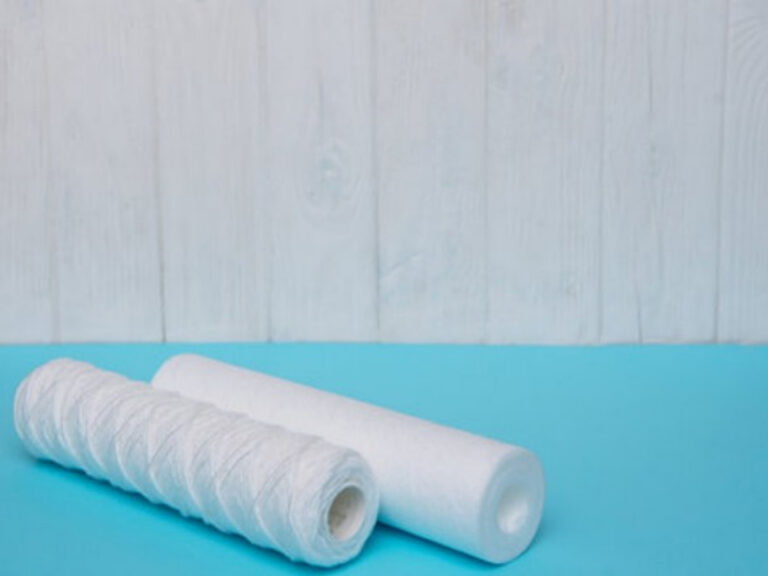
Un préfiltre fritté ou en profondeur peut fonctionner lorsque les solides sont principalement déformables et mélangés. Quelque chose comme un Filtre à poudre PE fritté 10-50 microns s'inscrit naturellement comme un point de discussion robuste pour le pré-polissage lorsque le processus peut tolérer les milieux polymères et que le régime chimique est compatible.
Mais il y a un hic : sacrificiel ne veut pas dire négligent. L'étape sacrificielle doit être facile à ouvrir, facile à vidanger, facile à rincer et suffisamment bon marché pour être encrassée sans drame.
Schéma 2 : Banques de logements parallèles pour les conditions de floraison
Les banques parallèles ne sont pas un luxe. Elles sont une assurance.
Lors d'une filtration normale à l'entrée de l'eau de mer, le train A et le train B peuvent se partager la charge de manière égale. Lors d'une efflorescence, les opérateurs peuvent réduire la vitesse, faire pivoter le nettoyage ou isoler un banc encrassé tout en maintenant le flux dans le reste du train. Si le schéma n'a pas de pensée N+1, l'opérateur devient la redondance.
La NOAA a indiqué que le 2024 efflorescence cyanobactérienne dans l'ouest du lac Érié a atteint un indice de gravité de 6,6, plus intense que celle de 2023 5.3, mesurée sur la période de pointe de 30 jours de la biomasse par imagerie satellitaire. Il s'agit d'eau douce, certes, mais la leçon que l'on peut en tirer se vérifie : l'intensité de la floraison n'est pas théorique, et les concepteurs de prises d'eau qui ne tiennent pas compte des impulsions de la biomasse jouent avec les temps d'arrêt.
Pour l'eau de mer côtière, les banques parallèles doivent inclure :
Variable de mise en page
Faiblesse de la conception
Meilleure conception
Pourquoi c'est important
Logement
Récipient unique à écoulement total
2 x 50% ou 3 x 50% banques
Permet d'isoler l'appareil en cas d'encrassement
Chargement à la première étape
Vitesse faciale élevée
Faible vitesse, surface surdimensionnée
Réduit l'aveuglement rapide
Drainage
Petit drain latéral
Vidange complète par le bas avec chemin d'accès à la chasse d'eau
Elimine le sable et les débris de coquillages
L'instrumentation
Un manomètre d'entrée
ΔP pour chaque banque
Indique le train en panne
Accès au nettoyage
Espace de maintenance réduit
Espace de tirage des cartouches + plan de levage
Réduction du temps de panne
Matériaux
SS304 par défaut
SS316/316L dans les zones à forte teneur en chlorure
Réduit le risque de corrosion
Stratégie en matière de cartouches
Un micron partout
Étagé 50 → 20 → 5 → 1 micron logique
Prévient l'échec prématuré du polissage
C'est ici que cartouches filtrantes à haut débit micron personnalisées deviennent plus qu'un simple article de catalogue. En service d'eau de mer, les cartouches à haut débit doivent être considérées comme une partie intégrante de l'agencement hydraulique, et non comme un remplacement miracle d'un mauvais agencement.
Schéma 3 : Isolation duplex avant la filtration de précision
Si l'usine ne peut pas s'arrêter, la conception du boîtier du filtre nécessite une isolation duplex. C'est simple.
Une disposition duplex permet à un navire de fonctionner pendant que l'autre est entretenu, ou permet aux deux de fonctionner en cas de charge maximale. Pour les petits skids de filtration de prétraitement de dessalement, le polissage des prises d'eau d'aquaculture, les boucles industrielles de refroidissement de l'eau de mer et les systèmes de traitement de l'eau de mer, les boîtiers duplex l'emportent souvent sur un seul grand boîtier parce qu'ils offrent des choix aux opérateurs.
Le schéma auquel je me fie ressemble à ceci :
L'eau de mer brute dégrillée entre dans un collecteur commun, se divise en deux trains de boîtiers à valve d'isolation, passe à travers des cartouches ou des éléments réutilisables échelonnés, puis rejoint un collecteur de sortie commun doté d'une protection anti-retour. Chaque côté dispose d'une ventilation, d'une vidange, d'une mesure ΔP indépendantes et d'un espace suffisant pour retirer la cartouche la plus longue sans la faire basculer comme une lance.
Et oui, je veux des points d'échantillonnage. Avant et après. La turbidité, le SDI15, la numération des particules, les contrôles microbiens, l'oxydant résiduel et les tests visuels sur les bocaux permettent toujours de détecter des éléments qui échappent aux tableaux de bord.
Pour une étape de polissage de type sanitaire plus serré, un Boîtier de filtre à cartouche SS304/SS316 Code 7 de 20 pouces peut s'adapter là où l'intégrité de l'étanchéité est importante. Mais pour les prises d'eau côtières brutes ou semi-brutes, la question n'est pas de savoir s'il peut contenir une cartouche. La question est : “Peut-il survivre aux abus lors de son ouverture répétée par des personnes fatiguées portant des bottes mouillées ?”
Schéma 4 : cartouches multiples après le contrôle des solides
Les boîtiers à cartouches multiples doivent être utilisés après l'élimination des solides les plus grossiers. Je sais que cela semble conservateur. C'est une bonne chose.
Un grand boîtier de filtre d'entrée marin rempli de cartouches fines peut sembler efficace sur le papier, mais s'il reçoit de l'eau non conditionnée, il devient un collecteur de boues coûteux. Le rôle correct des boîtiers à cartouches multiples est généralement post-défilage, post-média, post-DAF ou post-cartouche grossière, où ils stabilisent la qualité de l'eau avant l'UF, l'OI, les échangeurs de chaleur, les buses de pulvérisation ou l'équipement de traitement sensible.
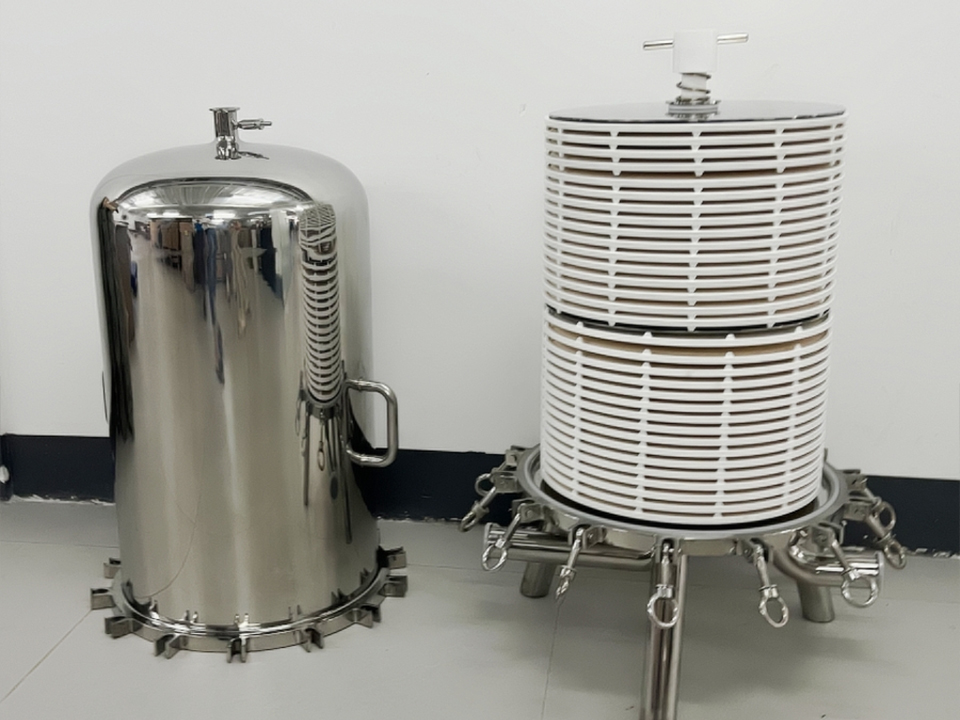
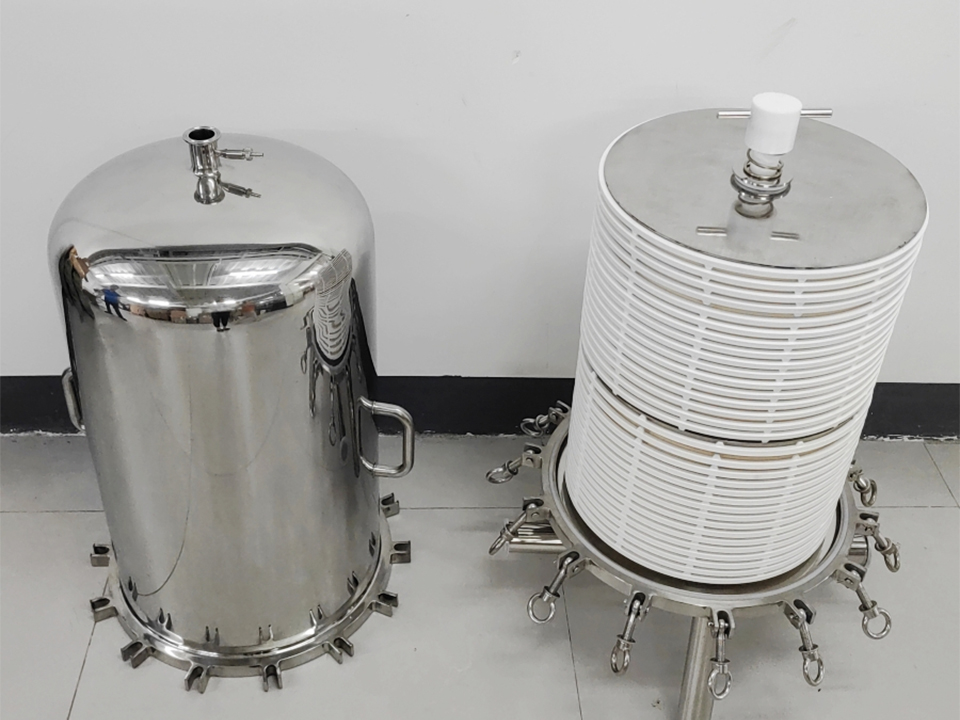
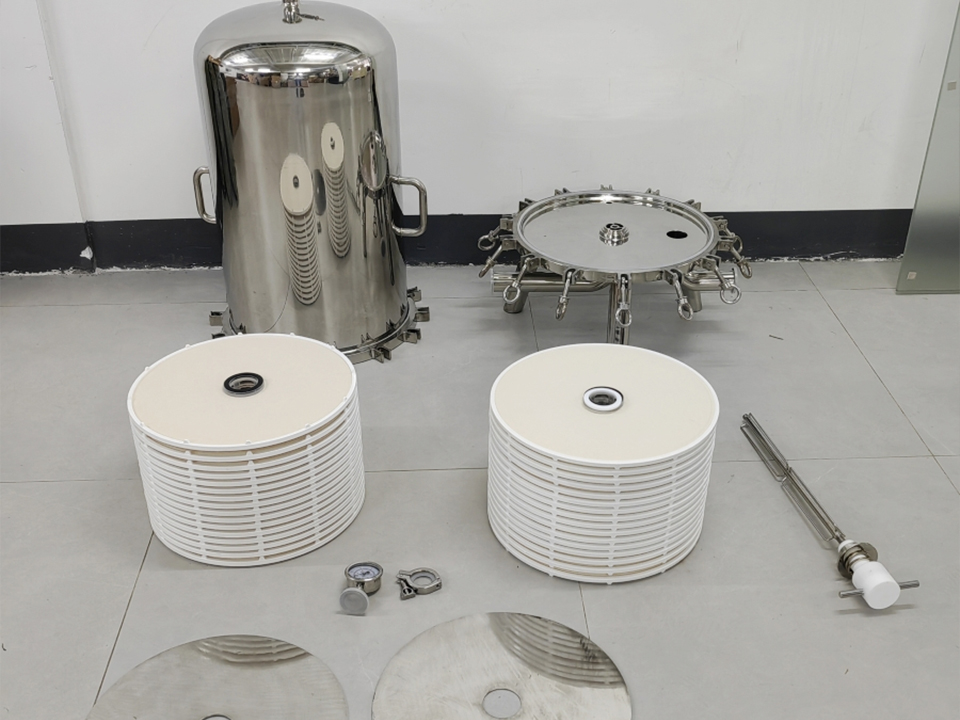
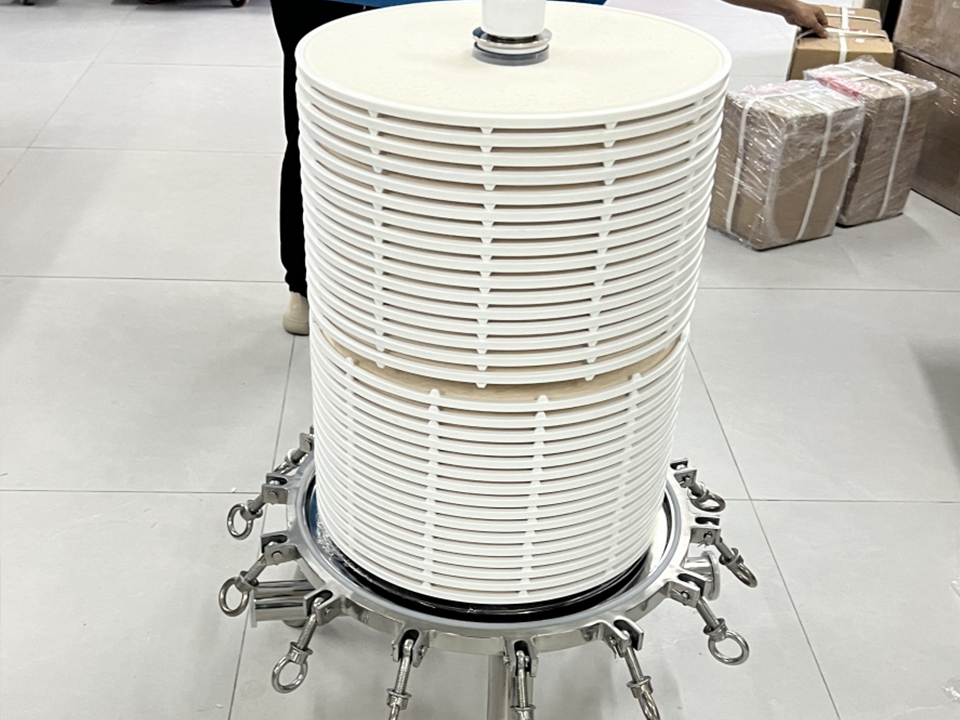
C'est là qu'un boîtier de filtre multi-cartouche en acier inoxydable devient pertinent pour la conversation technique, même si l'exemple biopharmaceutique est plus propre que le service d'eau de mer. L'idée mécanique reste importante : éléments multiples, enveloppe de pression commune, capacité de débit plus élevée et normalisation plus facile entre les skids.
Mais ne cachez pas un boîtier à plusieurs cartouches dans un coin. Donnez-lui un espace de levage. Donnez-lui de l'espace pour retirer les bobines. Prévoyez un plan de rinçage. Des manomètres que les opérateurs peuvent lire sans avoir à s'accroupir sous la tuyauterie.
Un mauvais accès pour la maintenance n'est pas un petit défaut. Il s'agit d'un futur temps d'arrêt avec des vêtements de CAO propres.
Le piège du micron dans la filtration de l'eau de mer
Je vois cela tout le temps : quelqu'un veut une “meilleure filtration”, alors il passe à 1 micron.
Mauvaise séquence.
A Cartouche de filtre à eau en PP de 1 micron peut être utile en tant qu'élément de polissage final dans un système par étapes. Il ne s'agit pas d'un soldat de première ligne pour les eaux côtières brutes. S'il est mis en place trop tôt, il aveugle rapidement, fait grimper le ΔP, crée des tentations de contournement et apprend aux opérateurs à détester l'ensemble du prétraitement.
La meilleure progression est généralement la suivante : dégrilleur grossier, dégrilleur fin, média ou DAF si nécessaire, cartouche grossière, cartouche moyenne, puis cartouche fine. Les valeurs exactes dépendent de la qualité de l'eau, de la tolérance en aval et de la philosophie de nettoyage, mais la logique est stable : il faut enlever les grosses matières peu coûteuses avant de demander aux médias fins de faire des miracles coûteux.
Les documents de la Commission côtière de Californie datant de 2024 montrent également pourquoi les discussions sur les grillages peuvent devenir politiquement et techniquement compliquées. Lors d'un examen préliminaire, un Tamis de 1,0 mm ou moins a été décrite comme ne produisant qu'une Réduction 1% dans le CSA selon les hypothèses de dessalement du Plan Océan, alors que les calculs spécifiques à l'espèce de l'éperlan à long bec impliquaient des estimations de réduction très différentes. Traduction : “écran plus petit” ne signifie pas automatiquement “impact environnemental réduit”.”
Matériaux : SS316 n'est pas une spécification excessive à proximité de l'eau de mer chaude
Le SS304 convient à de nombreuses applications dans l'eau. L'eau de mer chaude ne fait pas partie des “nombreuses applications”.”
Pour la conception des boîtiers de filtre en service côtier riche en chlorures, SS316 ou 316L est souvent la référence pratique parce que le molybdène améliore la résistance aux piqûres par rapport à SS304. Mais même l'inox 316 n'est pas invincible. Les crevasses, les zones stagnantes, le mauvais nettoyage des soudures, la saumure piégée, les rainures des joints et les pattes mortes peuvent toujours devenir des sites de corrosion.
La règle absolue : concevoir le logement de manière à ce que l'eau de mer ne soit pas stockée dans un endroit où les gens ne peuvent pas l'évacuer.
Cela signifie des drains inclinés, des soudures passivées, des fixations compatibles, du matériel de fermeture qui ne colle pas, une chimie des joints appropriée, et pas de supports en acier au carbone qui touchent l'acier inoxydable dans une pièce humide à l'air salin. Si le nettoyage chimique utilise des acides, des caustiques, du NaOCl ou des agents réducteurs, vérifiez la compatibilité avant l'achat, et non après l'apparition de taches brunes.
Un boîtier n'est pas seulement un récipient sous pression. C'est une expérience de corrosion à laquelle est attaché un bon de commande.
Comparaison : Dispositions du logement du filtre pour les systèmes de prise d'eau côtière à fort encrassement
Disposition du boîtier du filtre
Meilleur cas d'utilisation
Tolérance à l'encrassement
Charge de l'opérateur
Risque en cas de mauvaise application
Mon verdict
Boîtier de cartouche à flux complet unique
Petit cours d'eau latéral à faible encrassement
Faible
Moyen
Fermeture rapide en cas d'efflorescence ou d'envasement
Accepter uniquement pour le polissage non critique
Boîtier grossier sacrificiel
Eau d'admission brute ou semi-défilée
Moyenne-élevée
Faible-moyen
La mauvaise conception du drain le transforme en un pot de boue
Une option solide pour la première phase
Boîtiers de cartouches recto-verso
Fonctionnement continu avec entretien manuel
Moyen
Moyen
Une mauvaise logique des vannes provoque des dérivations ou des jambes mortes
La meilleure disposition pratique pour de nombreux skids
Banques multilogements parallèles
Filtration de prétraitement de dessalement à haut débit
Haut
Moyenne-élevée
Nécessité d'une plus grande empreinte et d'une meilleure instrumentation
Idéal pour les systèmes de prise d'eau côtière importants
Cuve de polissage à cartouches multiples
Post-sélection ou polissage post-média
Moyen
Moyen
Les cartouches fines sont aveugles si elles sont placées trop tôt
Excellent lorsqu'il est mis en scène correctement
Boîtier final fin de 1 micron
Protection du RO, de l'UF, des buses ou de l'équipement sensible
Faible-moyen
Moyen
Utilisé trop tôt, il devient un feu de joie consommable.
Utiliser le mot "tard" et non le mot "premier".
Règles de conception sur lesquelles je ne ferais aucun compromis
Tout d'abord, chaque prise d'eau de mer à fort encrassement devrait avoir une base saisonnière d'encrassement réaliste. Pas des moyennes annuelles. Les événements de pointe. Les marées de printemps, le ruissellement des tempêtes, les périodes de prolifération des algues, les périodes de dragage, les saisons des méduses et les perturbations du trafic portuaire sont autant d'éléments qui entrent en ligne de compte.
Deuxièmement, toute installation sérieuse doit être isolée. Une installation sans vannes d'isolement autour des cartouches n'est pas une installation, c'est un arrêt qui attend une autorisation.
Troisièmement, mesurez la pression différentielle à chaque étage, et pas seulement la pression du système. La pression du système indique que le patient est malade. Le ΔP de l'étage vous indique où se trouve l'infection.
Quatrièmement, il faut éviter de polir trop tôt. Un élément de 1 micron placé avant le contrôle des solides grossiers revient à mettre un masque chirurgical sur un collecteur d'eaux pluviales.
Cinquièmement, n'oubliez pas les autorisations. Les directives californiennes stipulent que les installations de dessalement d'eau de mer doivent utiliser des puits souterrains ou des prises d'eau de surface filtrées, les prises d'eau souterraines étant privilégiées dans le cadre du Plan Océan lorsque les conditions du site le permettent. Ces mêmes directives précisent que les prises d'eau souterraines ne peuvent pas être utilisées partout, car l'hydrogéologie détermine ce qui est possible.
Sixièmement, il faut être honnête en ce qui concerne la romance des prises d'eau souterraines. Le rapport de juin 2024 du groupe d'experts californien sur les prises d'eau souterraines décrit les puits horizontaux, les galeries et les exigences spécifiques au site, telles que des sédiments perméables, des fonds marins stables et la nécessité d'éviter l'érosion ou les dépôts. Il note également que certaines technologies ont des antécédents limités ou des performances inférieures aux attentes dans des cas spécifiques.
Donc, oui, la subsurface peut réduire la charge directe de débris. Non, cela n'excuse pas une conception paresseuse du prétraitement en aval.
Comment concevoir un boîtier de filtre pour une prise d'eau de mer à fort encrassement ?
Commencez par le flux, mais ne vous arrêtez pas là.
Définir le débit normal, le débit de pointe, le débit minimum, le débit de lavage à contre-courant, le débit de dérivation et le fonctionnement à débit réduit en cas d'urgence. Définir ensuite les solides : distribution granulométrique, historique des algues, plage de turbidité, objectif SDI15, risque lié aux huiles et aux graisses, charge biologique, température, salinité et exposition aux oxydants.
Construisez ensuite le schéma en partant de l'équipement que vous protégez.
Dans le cas d'une unité de traitement des eaux usées, le carter doit protéger les membranes contre l'encrassement par les particules et le mucus biologique. Pour les échangeurs de chaleur, il doit protéger les petits passages et réduire les dépôts. Pour les eaux industrielles, il doit protéger les buses, les vannes, les joints et la qualité du produit final. Pour l'aquaculture, il doit filtrer sans créer de chocs chimiques ou de pression qui nuisent au système biologique.
La séquence générique que je préfère pour les travaux côtiers à fort encrassement est la suivante :
Tamisage → boîtier sacrificiel grossier → média optionnel/DAF/UF en fonction du chargement → boîtiers de cartouches duplex ou parallèles → boîtier de polissage final → équipement protégé en aval.
La séquence exacte des microns peut être 50 → 20 → 5 → 1 micron, ou 100 → 25 → 10 micron, ou quelque chose de plus étrange. La réponse correcte dépend des données relatives à l'encrassement. Quiconque vend une échelle universelle de microns vend de la confiance, pas de l'ingénierie.
FAQ
Qu'est-ce que la filtration de l'eau de mer ?
La filtration de l'eau de mer est l'élimination progressive des algues, du plancton, des coquillages, de la vase, des matières organiques dérivées des algues et des solides fins en suspension avant que les pompes, les cartouches, les skids UF ou les membranes SWRO ne reçoivent l'eau côtière, à l'aide de tamis, de médias, de cartouches, de boîtiers duplex et de cuves en acier inoxydable drainables dimensionnées pour les pics d'encrassement.
Concrètement, il s'agit d'un système défensif. Il ne s'agit pas seulement de donner à l'eau une apparence de propreté. Il s'agit de maintenir la chute de pression stable, de protéger les actifs en aval, de réduire la fréquence des nettoyages et d'éviter qu'une marée sale ne devienne une panne de l'usine.
Quelle est la meilleure disposition des filtres pour les systèmes de prise d'eau côtière ?
La meilleure configuration de filtre pour les systèmes de prise d'eau côtière est généralement une conception par étapes avec un dégrillage grossier, une préfiltration sacrificielle, des batteries de cartouches parallèles ou doubles, et un polissage final seulement après que les gros solides et les débris de blooms ont déjà été éliminés de la trajectoire d'écoulement.
J'éviterais toute configuration à vaisseau unique pour un service critique, à moins que le débit soit faible, que la prise d'eau soit bien protégée et que l'arrêt soit acceptable. L'eau de mer à fort encrassement a besoin de redondance, d'isolation, de drains et d'une surface suffisante pour survivre à une mauvaise semaine, et pas seulement à une journée moyenne.
Dois-je utiliser un boîtier de filtre en SS304 ou SS316 pour l'eau de mer ?
Le boîtier de filtre en SS316 est généralement le choix le plus sûr pour l'eau de mer, car les eaux côtières riches en chlorures augmentent le risque de piqûres, de corrosion par crevasses et d'attaque des zones soudées, en particulier lorsque des températures chaudes, des zones stagnantes, des oxydants ou une exposition répétée au sel humide et sec sont présents autour du navire.
Le SS304 peut fonctionner dans des conditions légères, intermittentes ou non critiques, mais je n'en ferais pas mon choix par défaut pour la filtration de l'air d'admission dans les régions côtières chaudes. L'économie réalisée à l'achat peut disparaître rapidement une fois que la corrosion, les fuites de joints, le grippage des boulons ou le remplacement d'urgence entrent dans le carnet d'entretien.
Les cartouches de 1 micron sont-elles adaptées aux prises d'eau de mer à fort encrassement ?
Une cartouche de 1 micron ne convient qu'en tant que filtre de polissage tardif après que les solides grossiers, les amas d'algues, les graviers de coquillage et la plupart des charges en suspension ont déjà été éliminés par des tamis, des médias, des cartouches sacrificielles ou d'autres équipements de prétraitement situés en amont.
Utilisé trop tôt, il devient un générateur de chute de pression. Utilisé correctement, il protège les membranes, les buses, les joints et les équipements sensibles en aval. La différence n'est pas la valeur nominale de la cartouche. La différence réside dans l'agencement du boîtier qui la précède.
Comment réduire la fréquence de remplacement des cartouches dans la filtration du prétraitement du dessalement ?
La fréquence de remplacement des cartouches est réduite par la diminution du flux, l'augmentation de la surface du logement, l'ajout d'étages sacrificiels en amont, l'utilisation de bancs parallèles, la surveillance de la pression différentielle par étage et la sélection de microns en fonction de la charge réelle de particules plutôt qu'en se basant sur des tables de débit d'eau propre.
L'erreur la plus coûteuse consiste à considérer les cartouches comme la première barrière contre tous les contaminants. Elles devraient faire partie d'une défense échelonnée. Si les cartouches retiennent chaque jour des fragments de varech, des débris de coquillages et de la vase d'efflorescence, c'est que le système en amont est mal conçu.
CTA : Construire l'aménagement avant d'acheter le navire
Si vous spécifiez une filtration d'entrée d'eau de mer pour une usine côtière, un skid de prétraitement de dessalement, un système de traitement marin ou une boucle d'eau industrielle à haute teneur en chlorure, ne commencez pas par vous demander de quelle taille de boîtier j'ai besoin.“
Commencez par le comportement en matière d'encrassement. Ensuite, il faut prévoir l'agencement du boîtier. Sélectionnez ensuite les matériaux, les indices de micron, la géométrie de la cartouche, les joints, les drains, les vannes et l'accès pour la maintenance.